The Collagen Myth: Why You Cannot Apply Elasticity from a Jar
Collagen is the gold standard for firm skin, but applying it topically won't boost your elasticity. A cosmetic chemist explains the molecular limits of skin absorption.
 Dr. Jihye Kim
Medical doctor, specialist, Laplace Clinic · Laplace Clinic, Sinchon, Seoul · June 8, 2026 · 5 min read
Pick up almost any anti-aging cream, and the label will likely highlight collagen. We are told that applying it topically will restore the plumpness, firmness, and elasticity of youth. It is an appealing promise: a quick swap of lost collagen from a jar directly into your skin. Unfortunately, as a matter of basic molecular physics, it is a promise that cosmetic chemists know is impossible to keep.
You cannot simply smear collagen onto your skin and expect it to join the collagen network in your dermis. The barrier is far too smart for that.
The molecular weight barrier: Dalton’s 500 rule
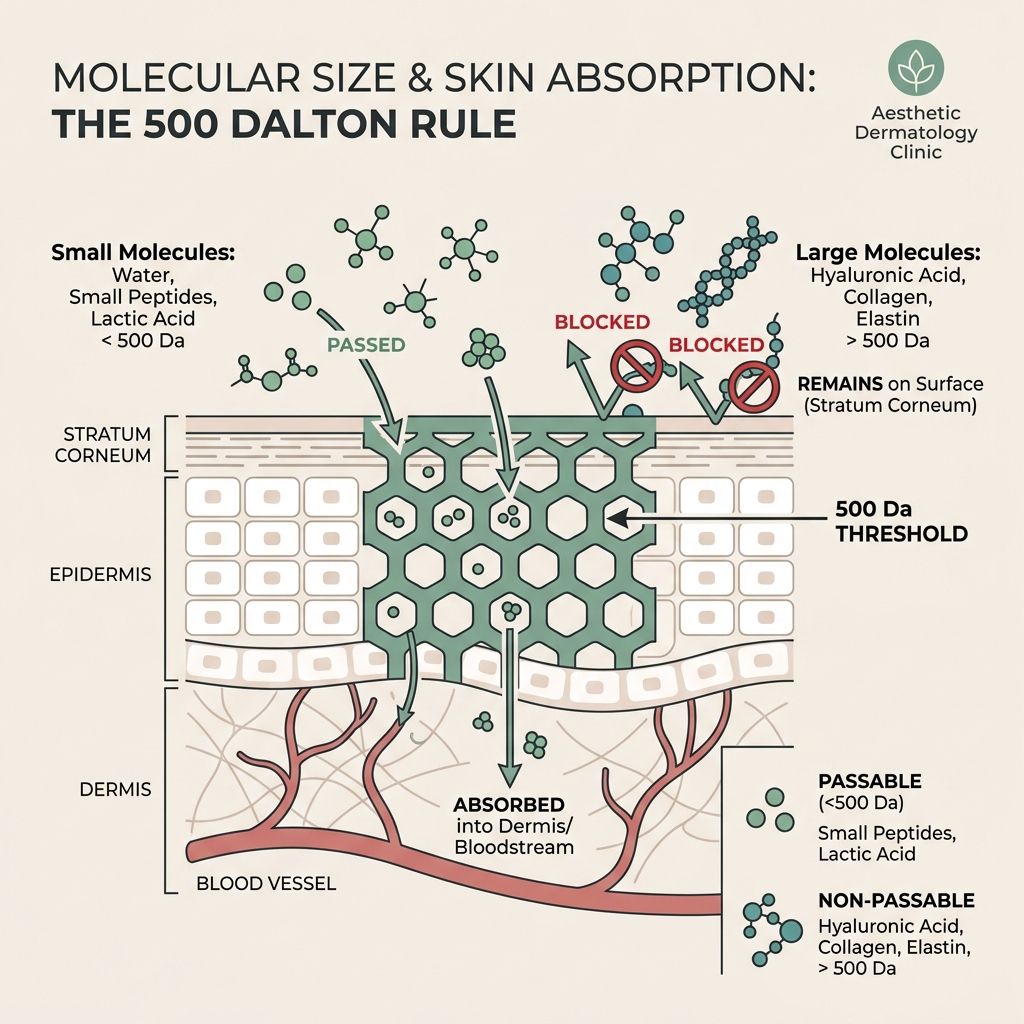
To understand why topical collagen fails to firm, we have to look at molecular size. In dermatology, the standard rule of skin absorption is Dalton's 500 rule: any molecule larger than 500 Daltons (Da) cannot penetrate an intact stratum corneum (the skin's outermost protective layer). Anything larger remains sitting on top.
Collagen is a massive, complex triple-helix protein. Its molecular weight sits at roughly 300,000 Daltons. To put that in perspective, trying to absorb a collagen molecule through your skin barrier is equivalent to trying to pass a boulder through a window screen. The barrier simply blocks it.
What topical collagen actually does: surface hydration
This does not mean collagen creams are useless; it just means their marketing is misleading. While collagen cannot penetrate the skin to rebuild elasticity, it is an excellent humectant. Because of its large size, it sits on the surface of your skin and binds water, acting like a damp sponge. This provides intense surface hydration, smoothing out fine lines temporarily and leaving the skin feeling soft and plump.
This is a great cosmetic benefit, but it is purely temporary hydration. The moment you wash your face, that collagen (and its bound moisture) washes down the drain. It has done nothing to change the structural elasticity of the dermis below.
What actually rebuilds skin: active alternatives
If you want to genuinely increase collagen in your skin, you must focus on ingredients that can cross the barrier and signal your fibroblasts (the cells that make collagen) to synthesize new proteins. These include:
- Retinoids (Retinol, Retinal): Retinoids pass the barrier and bind to cell receptors, directly commanding cells to increase turnover and trigger collagen synthesis.
- Peptides: Short chains of amino acids that are small enough to pass the barrier. They act as messengers, tricking the skin into thinking it has lost collagen and needs to build more.
- Polynucleotides (PDRN): Extracted salmon DNA skin boosters (like Rejuran) that are micro-injected past the barrier to directly signal fibroblasts for barrier repair and elasticity.
The takeaway
Skip the expensive collagen creams. Use collagen purely as a surface hydrating agent, and rely on evidence-backed actives to do the actual heavy lifting. When it comes to real elasticity, what you signal your skin to do is infinitely more valuable than what you apply on top.
Frequently Asked Questions
Can collagen in skincare products penetrate the skin?
Collagen molecules are generally too large to penetrate the skin, so they mostly sit on the surface, providing temporary hydration rather than boosting elasticity.
What benefits can topical collagen provide?
Topical collagen can help improve the skin's hydration and create a smooth surface, but it does not enhance elasticity or firm the skin.
How can I improve my skin's elasticity?
To improve skin elasticity, focus on ingredients like retinoids, peptides, and vitamin C, which support collagen production and skin health.
This article is for general information and is not medical advice. Consult a qualified healthcare provider about your individual situation.