Korea Skin Booster Trip Planner: 5-Day Seoul Timeline (2026)
A neutral planning hub for getting a skin booster in Korea on a short trip. It puts downtime, how to read a price quote and flight timing in one plan, so you can plan your days before you book.
If you are planning a korea skin booster treatment on a short trip, decide three things before you book: which product category suits your goal, how many days of visible marks you can accept, and how many recovery days you can leave before your flight. Prices change between clinics and over time. The foreign-tourist VAT refund on cosmetic procedures ended on 31 December 2025, so treat any 2026 quote as the final amount you pay. This guide puts these factors in one place and lists the questions to ask a licensed doctor. It does not rank clinics or promise results.
This article is general information, not medical advice. Skin boosters are injections or device-assisted procedures, and they carry real risks. Have a consultation with a licensed doctor who has examined your skin before you decide.
What 'skin booster' means in Korea
In Korean clinics, 'skin booster' is a loose umbrella term, not a medical category. It usually covers products injected into the skin in many small, shallow points, or delivered with a device, to improve skin quality: texture, hydration, fine lines or overall look. It usually does not mean volume filler, although some products sit close to that line.
International visitors most often ask about three names:
- Rejuran: a polynucleotide (PN) injectable made from purified salmon DNA fragments.
- Juvelook: an injectable that combines PDLLA, a biostimulating polymer, with hyaluronic acid.
- Exosome treatments: a broad, fast-moving category. Some are applied to the skin after a device treatment and some are offered by injection, depending on the product and the clinic. Their approval status differs from product to product, so ask the clinic exactly which product it is and what it is approved for.
For a deeper look at how these differ in pain, bumps and the way they work, see our companion article [The Skin Booster Bible: Rejuran vs. Juvelook vs. Exosomes](/seoul-guide/skin-booster-bible-rejuran-juvelook-exosomes-guide). This page focuses on planning: time, money and travel logistics.
Korea skin booster comparison: downtime, price and flight timing
Here is *what to check* for each category. We do not list prices or day counts here, because they change by clinic, product amount and your skin. Fill in the blanks with the written answers from your clinic.
- Rejuran (PN): many small injections, by hand or with a device. Common short-term marks are small bumps, redness and possible bruising. Ask about infection, allergic reaction and bruising.
- Juvelook: injection. Common short-term marks are bumps, swelling and possible bruising. Ask about nodules or lumps, infection and allergic reaction.
- Exosomes: applied to the skin after a device treatment, or injected, depending on the product. Marks depend on the device or injection used. Ask about the product's origin and approval status, and infection.
- For all three: ask whether VAT is included (there is no tourist refund in 2026), and ask the treating doctor how long to wait before your flight for your plan.
How to use this list: take a screenshot, bring it to your consultation and ask the clinic to fill in each blank in writing for *your* treatment plan. A clinic that answers clearly and puts it in writing is easier to compare than one that only quotes a single headline price.
How to read a skin booster price quote in Korea
Price is the most searched and least comparable part of this topic. Two quotes for the 'same' booster can differ because they describe different things. Before you compare numbers, check:
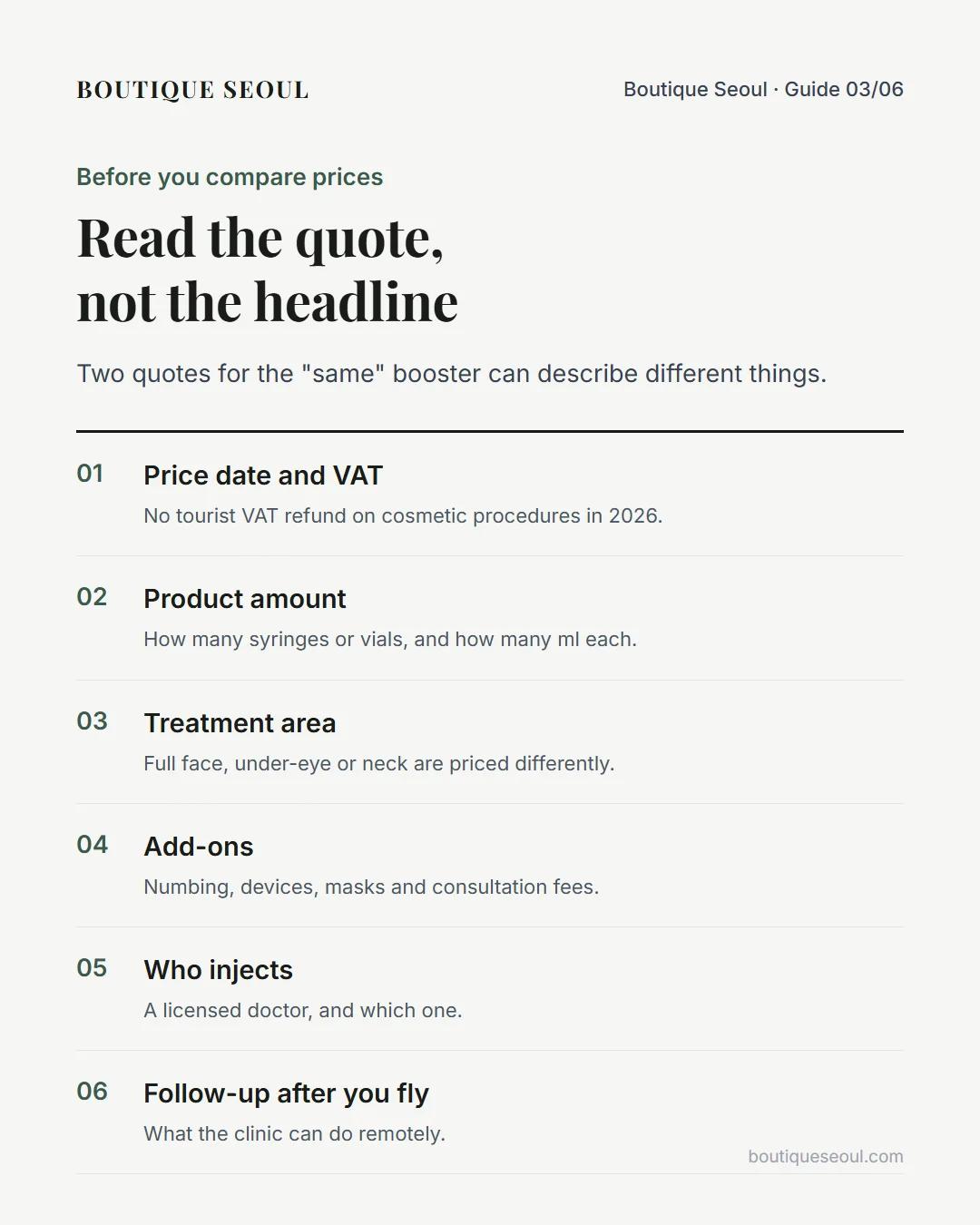
- Price date. Ask when the price was set and whether it is a limited-time event price. Promotions on booking platforms can change quickly.
- VAT. Ask whether VAT is included. The foreign-tourist VAT refund on cosmetic procedures ended on 31 December 2025 and is not available in 2026. Do not plan your budget around a refund.
- Amount of product. Ask how many syringes or vials are included, and how many millilitres each contains.
- Treatment area. Full face, under-eye only, neck? Price per area is not the same as price per session.
- Add-ons. Numbing cream, a device used to deliver the product, soothing masks, aftercare products and consultation fees may be charged separately.
- Who injects. Ask whether a licensed doctor performs the injection and who that doctor is.
- Follow-up. If a problem appears after you fly home, what can the clinic offer remotely, and is that included?
If you are comparing quotes through booking platforms, our guide [How Do Foreigners Book Skin Clinics in Korea?](/seoul-guide/k-dermatology-booking-apps-comparison-for-foreigners) explains how the main platforms differ. For questions to ask at the consultation itself, see [Seoul Skin Clinic Guide: 7 Questions to Ask Before You Book](/seoul-guide/seoul-skin-clinic-questions).
Planning a skin booster around a short Seoul trip
The basic rule: put the treatment early and the flight late. This gives the most room for swelling, bruising or bumps to settle, and for you to go back to the clinic if something does not look right.
A sample framework for a 5-day trip (adjust it to your doctor's advice):
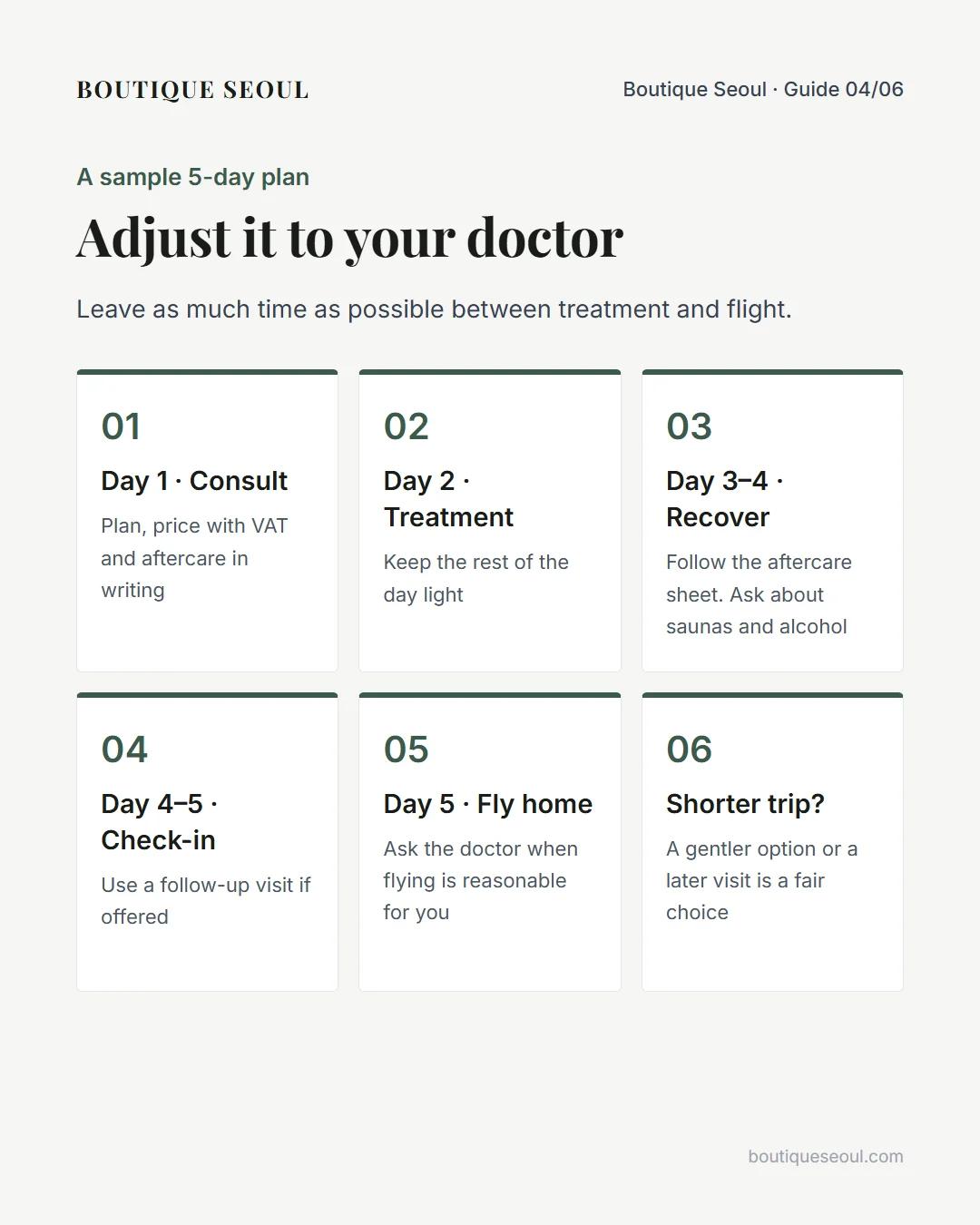
- Day 1: arrive and consult. Have the consultation and confirm the plan, price (with VAT) and aftercare instructions in writing. Do not feel pressured to have the treatment the same day.
- Day 2: treatment. Keep the rest of the day light. Avoid scheduling photos, dinners or events where visible marks would bother you.
- Day 3–4: recovery and sightseeing. Follow your aftercare sheet. Ask the clinic beforehand about saunas, jjimjilbang, intense exercise and makeup. Our article on [alcohol after skin treatments in Korea](/seoul-guide/i-thought-makgeolli-was-rice-milk-alcohol-after-skin-treatment-seoul) covers one of the most common questions.
- Day 4–5: check-in. If the clinic offers a follow-up visit, use it before you leave.
- Day 5: fly home. Leave as much time as possible between treatment and flight.
If your trip is shorter, consider whether a skin booster suits this trip at all. Choosing a gentler option, or leaving the treatment for a longer visit, is a reasonable decision.
For general flight aftercare, see [Flying After Skin Treatments: How to Plan Your Itinerary & Flight Aftercare](/seoul-guide/flying-after-skin-treatments-flight-aftercare-guide).
Risks and side effects to take seriously
Skin boosters are often marketed as 'low downtime', but they are still medical procedures. Side effects that can occur include:
- Redness, swelling, small bumps and bruising at injection points. These are common in the short term.
- Pain or tenderness during and after treatment.
- Infection, if the skin barrier is broken and hygiene or aftercare fails.
- Allergic or hypersensitivity reactions to the product or the numbing cream.
- Lumps or nodules, which some products may cause. Ask the doctor about this for your specific product.
- Uneven or disappointing results. No product can guarantee a particular outcome.
- Vascular complications are rare with superficial boosters but are a known risk of facial injections in general. Ask what the clinic would do if one happened.
Tell the doctor about pregnancy or breastfeeding, active skin infections or cold sores, autoimmune conditions, blood-thinning medication or supplements, recent other procedures, and any history of allergies or keloids.
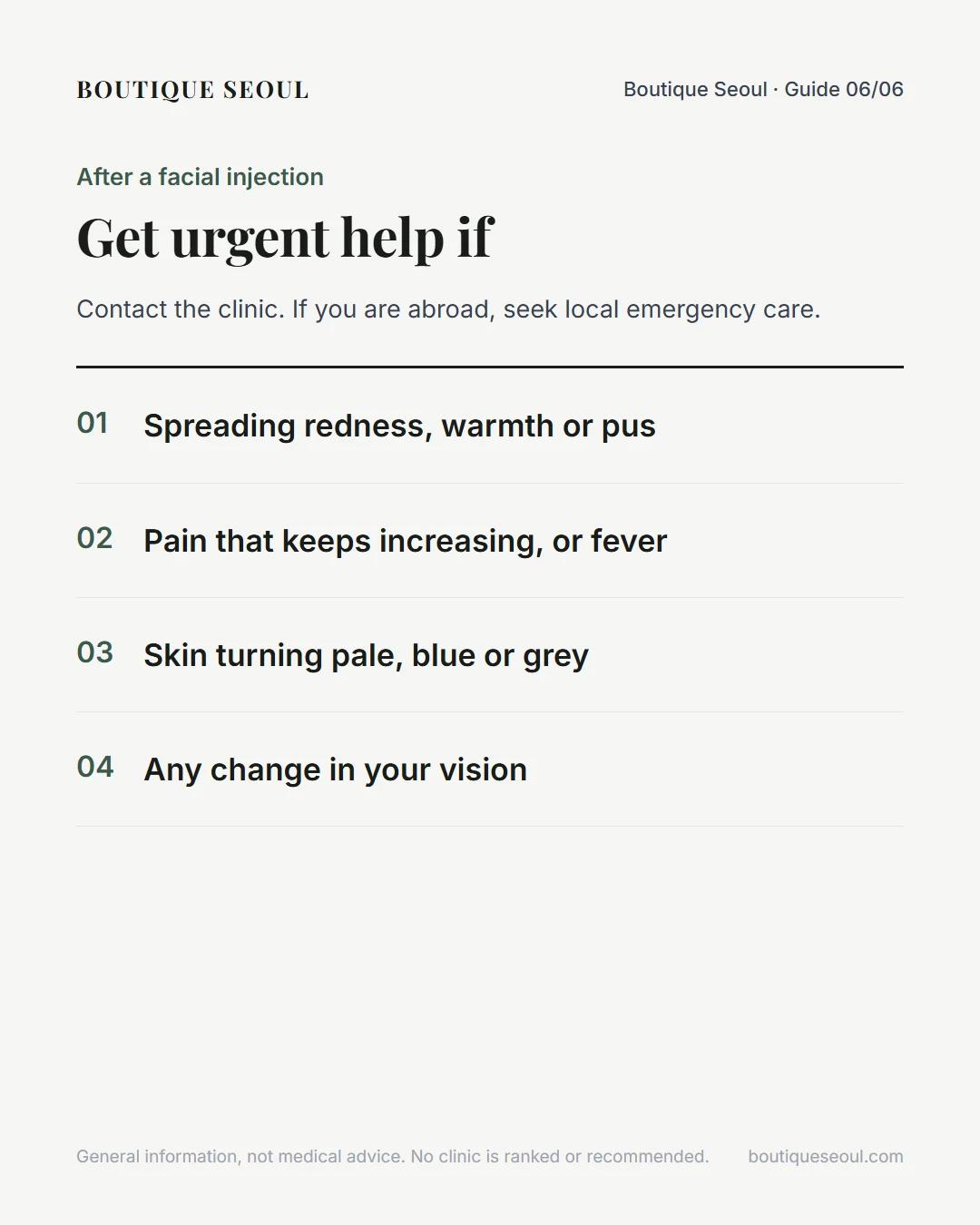
Get urgent medical help if you notice spreading redness, increasing pain, warmth, pus, fever, skin turning pale, blue or grey, or any change in vision after a facial injection. Contact the treating clinic, and if you are abroad, seek local emergency care. Public health sources such as the NHS guidance on cosmetic procedures explain how to choose a practitioner and what to do if something goes wrong.
Questions to ask the doctor before a skin booster
Bring this list to your consultation:
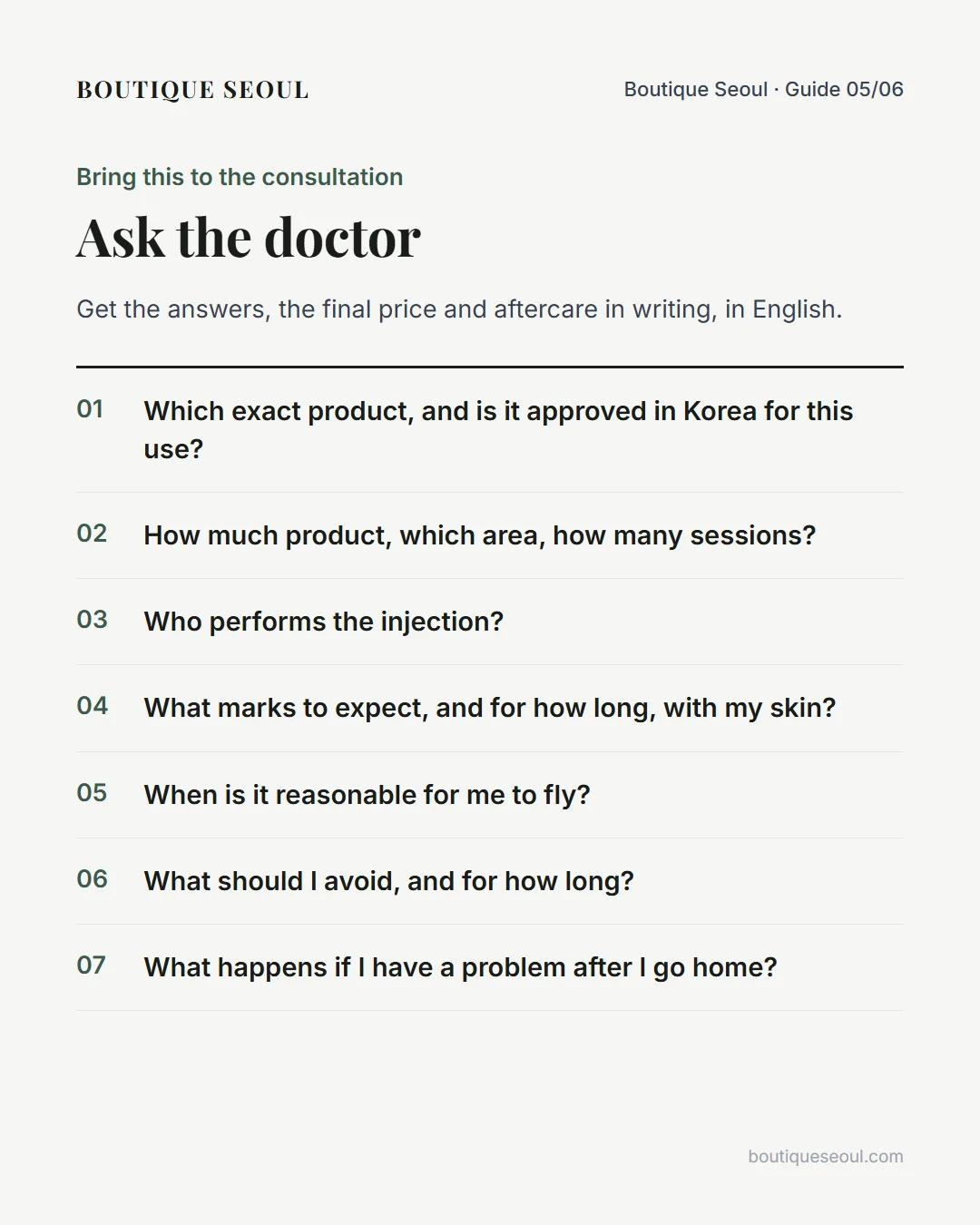
- Which exact product (brand and type) will you use, and is it approved in Korea for this use?
- How much product, over which area, and in how many sessions?
- Who performs the injection, and are they a licensed doctor?
- What marks should I expect, and for how many days, with *my* skin?
- When is it reasonable for me to fly, based on this plan?
- What should I avoid afterwards, and for how long?
- What happens if I have a problem after I go home?
- Can I have the final price, with VAT, and the aftercare instructions in writing in English?
Is a skin booster in Korea right for you?
A skin booster may fit your trip if your goal is skin quality rather than volume, you have at least a few days between treatment and flight, and you are comfortable with short-term visible marks. It may not fit if you only have one or two days, have an important event right after treatment, or have a medical condition the doctor advises against.
The most useful outcome of a consultation is a clear, written plan you understand, even if that plan is to wait. Whatever you choose, make the decision with a licensed doctor who has examined your skin.
References
- NHS: Cosmetic procedures. https://www.nhs.uk/conditions/cosmetic-procedures/
- NHS: Cosmetic surgery abroad. https://www.nhs.uk/conditions/cosmetic-procedures/cosmetic-surgery-abroad/
Frequently Asked Questions
Which Korean skin booster has the shortest downtime?
It depends on the product, the injection technique, how many passes are done and your own skin. Visible bumps, redness and bruising are common for a short period after most injected boosters. Ask the treating doctor how many days of visible marks to expect for your specific plan before you book flights or events.
Is the tourist VAT refund still available for skin booster treatments in Korea?
No. The VAT refund for foreign tourists on cosmetic procedures ended on 31 December 2025. Any 2026 price quote should be read as the final amount you pay. Ask the clinic whether the quoted price already includes VAT.
How soon after a skin booster can I fly home?
There is no single safe number of days that applies to everyone. Many travellers plan the treatment early in the trip so they have recovery days before the flight. Ask the treating doctor directly about flying, cabin pressure, swelling and what to do if a complication appears after you leave Korea.
Are exosome treatments in Korea the same as Rejuran or Juvelook?
No. Exosome products are a different category, and their regulatory status and the way they are applied (for example topically after a device treatment, or by injection) can vary. Ask the clinic exactly which product is used, how it is applied and what its approval status is.
How many sessions do I need?
Clinics often describe skin boosters as a series rather than a single session, but the right number depends on your goals and your skin, and on what the doctor recommends. On a short trip you may only fit one session, so ask what a single session can realistically do and whether follow-up at home is possible.
This article is for general information and is not medical advice. Consult a qualified healthcare provider about your individual situation.